Beating the Heat: How Gas Turbine Inlet Fogging Secures Millions in Capacity Payments
This post explains how high-pressure inlet fogging cools turbine intake air, recovering up to 20% of lost......
Existing Customers Call 626-359-4550 Or Visit Customer Care

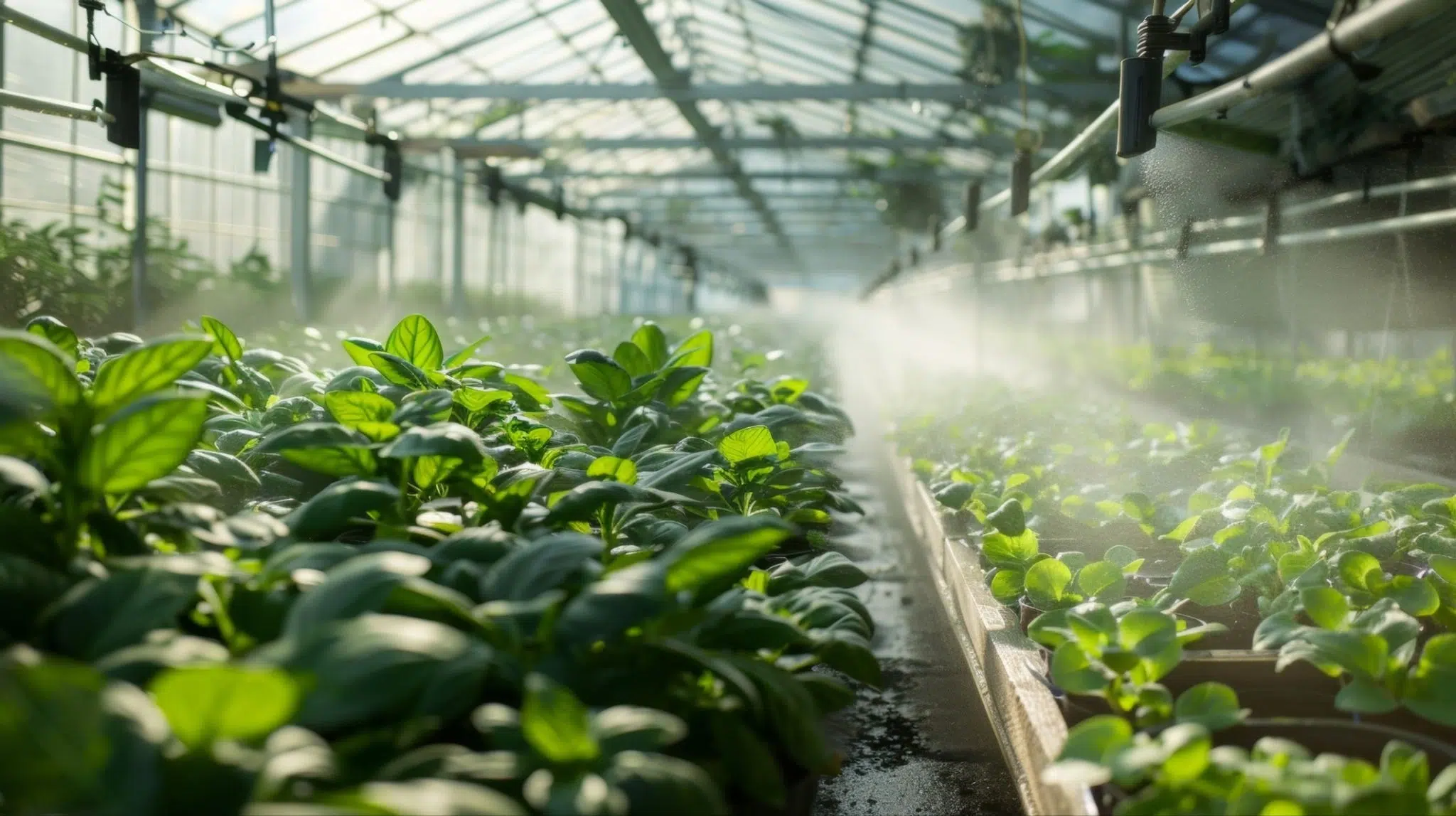
Greenhouse humidity needs can change significantly by crop and growth stage. Propagation areas may run at 90% RH or higher, whereas mature crops may need lower levels. High-pressure fogging allows for precise moisture control without soaking the growing medium. At the same time, ventilation, airflow, sensors, and temperature management help growers maintain the target environment.
Humidity can be one of the harder greenhouse conditions to maintain. Even in a controlled growing environment, it can change quickly as sunlight, outside temperature, irrigation, ventilation, and crop transpiration shift throughout the day.
These swings can directly affect how plants respond to their environment. Air that is too dry can increase transpiration and water demand, while prolonged high humidity can slow transpiration, increase condensation, and create better conditions for some fungal diseases.
Good greenhouse humidity control requires more than watching a single RH reading. Temperature, VPD, airflow, crop stage, and local weather can affect what the plants need.
Depending on the greenhouse and local climate, this may involve ventilation, evaporative cooling, high-pressure fogging, automation, or a combination of several systems.
Plants constantly move water from the root zone to the leaves. If greenhouse air becomes too dry, moisture loss can increase, placing greater demand on the plant’s water supply. At the other end of the scale, air nearing saturation can slow transpiration and make condensation more likely.
Relative humidity on its own does not give growers the full picture.
As per the University of Georgia Extension’s September 2026 controlled-environment agriculture guide, vapor pressure deficit (VPD) may provide a better indication of how air moisture affects plant transpiration, water uptake, nutrient movement, and stomatal activity.
UGA describes VPD above 1.0 kPa as relatively dry and values below 0.4 kPa as close to saturation. While these figures are useful as reference points, the right range still depends on crop type, growth stage, leaf temperature, and production goals.
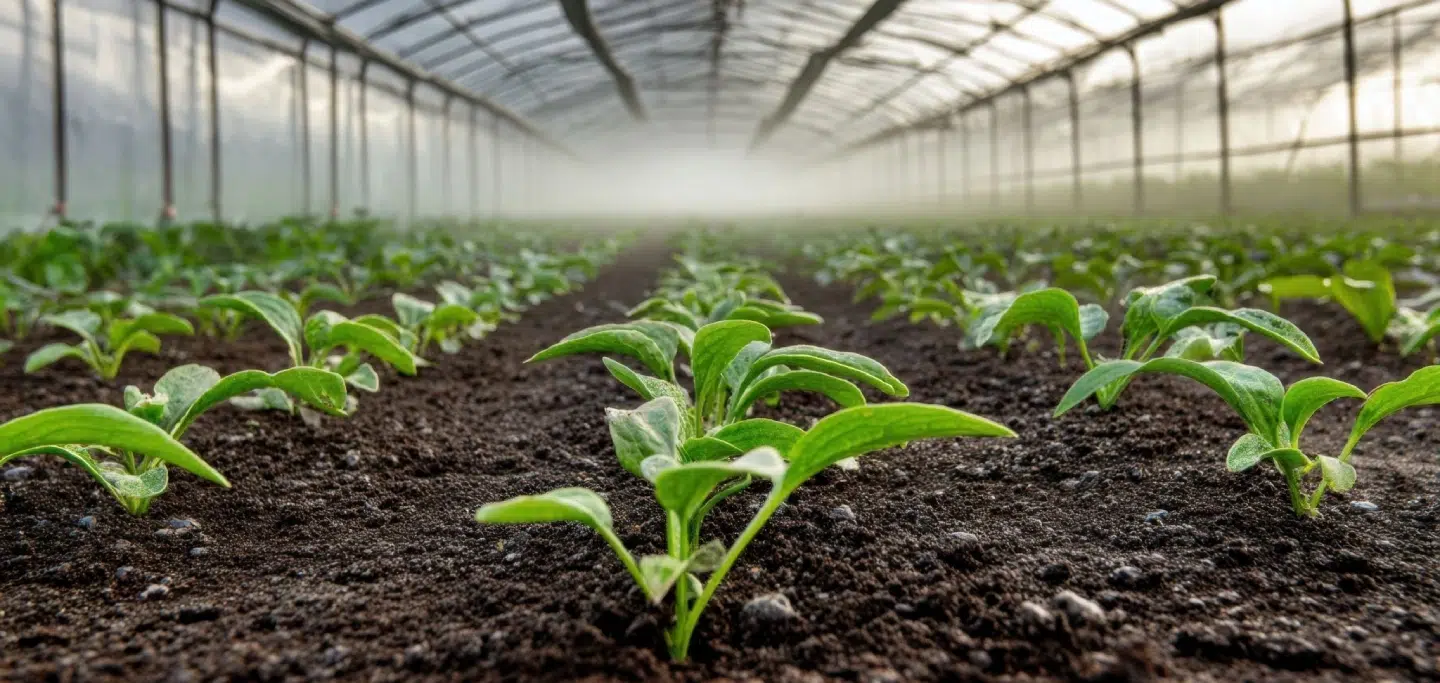
Propagation is a good example of why one humidity target does not work across an entire operation.
Fresh cuttings do not yet have a strong root system. They can lose water through their leaves faster than they can replace it, which makes the surrounding humidity especially important during early rooting.
In some propagation areas, this can mean maintaining relative humidity around 90% or even higher.
The idea is to slow moisture loss while roots develop, but without leaving the cuttings or growing medium soaked. Here’s where the way moisture is introduced into the air becomes important.
MeeFog’s Takao Nursery case study is a useful example. Takao Nursery in Fresno, California, uses high-pressure fogging over its propagation beds to maintain high humidity around cuttings and limit excess water in the growing medium. The original installation covered about 25,000 square feet of greenhouse space.
The tighter humidity control helped Takao manage difficult-to-propagate varieties and achieve turnover rates up to two times faster in propagation areas.
Larger operations may also need different humidity targets across separate growing zones. A propagation area can run at very high RH while established crops elsewhere in the facility operate at a lower target.
UConn Extension reported in June 2026 that Botrytis gray mold in tomatoes thrives above 90% RH, especially when free water remains on plant surfaces for four to six hours.
However, this does not mean every greenhouse should stay below 90% RH. It means crop stage, airflow, condensation, leaf wetness, and temperature must be considered alongside the RH reading. A propagation room intentionally running at high humidity has a different goal from a mature tomato house trying to reduce long periods of leaf wetness.
High-pressure fogging gives greenhouse operators a way to cool the air and add moisture at the same time.
The process starts with treated water moving through a high-pressure pump and stainless-steel distribution lines. From there, atomizing nozzles break the water into extremely fine droplets and release them into the greenhouse air.
As the droplets evaporate, they absorb heat from the surrounding air. This lowers the temperature while adding moisture, allowing the same system to support both humidification and evaporative cooling. A fogging system for greenhouses can work especially well during hot, dry conditions.
Droplet size has a significant influence on how well the process works. MeeFog’s proprietary impaction-pin nozzle uses a 150-micrometer (0.006-inch) orifice. At 2,000 psi, it produces an average droplet size below 10 micrometers.
Because smaller droplets have more surface area relative to their volume, they can evaporate more quickly into the surrounding air.
The MeeFog System brings the pump, atomizing nozzles, water treatment, stainless-steel distribution lines, and controls together as one system.
Of course, the greenhouse itself is important, too. Temperature, current RH, airflow, nozzle spacing, greenhouse height, and available evaporation distance can affect how much water the air can absorb.
The right greenhouse humidity and climate-control setup depends on the crop, growth stage, local climate, greenhouse design, and existing equipment.
Start by looking at:
An evaporative cooling greenhouse in a hot, dry region has more room for water to evaporate than a greenhouse already operating close to saturation.
Many operations also combine methods. Fogging may work alongside roof vents, circulation fans, pad-and-fan systems, or shade equipment as conditions change.
| System | Humidity and Temperature Effect | Footprint | Main Energy Load |
|---|---|---|---|
| High-pressure fogging | Adds humidity while providing evaporative cooling | Pump skid, tubing, nozzles | High-pressure pump and controls |
| Fan-and-pad | Cools incoming air while adding humidity | Pad wall, sump, fans | Fans and water pumps |
| Mechanical AC | Refrigerated cooling and possible moisture removal | Refrigeration and air-distribution equipment | Compressors and fans |
High-pressure fogging can be useful where you need distributed humidification with the added benefit of evaporative cooling, provided the greenhouse air can still absorb more moisture.
Before installing a fogging system, take a close look at water quality, nozzle coverage, zoning, airflow, sensor placement, and the way your crop fills the greenhouse. Water treatment deserves particular attention because high-pressure systems use small nozzle openings.
MeeFog’s greenhouse systems can include water softening, with reverse osmosis and additional filtration added where the application calls for it.
Routine service includes checking filters, nozzles, pumps, sensors, controls, and spray patterns. MeeFog’s 2026 high-pressure fog system maintenance guide recommends annual nozzle cleaning as a general standard, with cleaning every three to six months under hard-water or near-continuous operating conditions.
Cost and payback vary from one greenhouse to another. Crop value, existing cooling equipment, water treatment, energy rates, operating hours, and production gains can affect the calculation, so a site-specific analysis is more useful than a blanket ROI estimate.
There is no single RH range for every greenhouse crop. VPD gives you more context by accounting for the relationship between temperature and moisture. If you are setting plant humidity levels, use crop-specific guidance alongside RH, VPD, and leaf or air temperature.
Yes. Dry air has more capacity to absorb moisture, which gives evaporative cooling more room to work. As RH rises and the air moves closer to saturation, evaporation slows, so climate conditions need to be considered during system sizing.
MeeFog recommends annual nozzle cleaning as a general starting point. Hard water or heavy operating hours may call for cleaning every three to six months. Uneven spray patterns, dripping nozzles, or reduced output are good signs that the system needs inspection.
Dry air can increase transpiration and plant water demand. Very humid air can slow transpiration and increase the chance of condensation or extended leaf wetness. Knowing how to control humidity in greenhouse environments means looking at temperature, moisture, ventilation, and airflow together.
They can reduce unnecessary equipment operation by staging systems around actual greenhouse conditions instead of fixed schedules. Actual energy savings depend on the existing system, local climate, control strategy, crop requirements, and utility rates.
Unrooted cuttings can lose water through their leaves before they have enough roots to replace it. Very high humidity slows that moisture loss during the early rooting stage. The target should then be adjusted as roots develop and the plants become better able to manage their own water uptake.
Greenhouse humidification technology works best when it is treated as one part of the greenhouse climate strategy. Crop stage, weather, airflow, VPD targets, water quality, ventilation, and existing equipment can have a direct impact on how much cooling or moisture the greenhouse needs at any given time.
MeeFog designs high-pressure greenhouse systems around crop requirements, growing area, water quality, airflow, target humidity, and existing equipment rather than treating every space the same. Ready to review your current setup? Request a quote to discuss your greenhouse, propagation areas, and climate-control equipment.