Creating Mystical Fog Effects for Theme Parks and Themed Attractions
Learn how attraction designers and operators can use high-pressure water fog as a controllable atmospheric design to...
Existing Customers Call 626-359-4550 Or Visit Customer Care

Healthcare facilities maintain certain humidity levels to support patient safety and keep the efficiency of sensitive medical equipment.
Most hospitals follow the standard relative humidity (RH) set by ANSI, ASHRAE, and ASHE, which is at 20%–60% RH, depending on the room type. However, many institutions operate at 35%–45% RH for better control.
For years, this has been achieved with steam-based humidification systems. But recent updates to ASHRAE 170 now allow engineered non-steam systems (like adiabatic atomizing humidifiers) to be used, provided they comply with its hygiene and performance requirements.
HVAC systems in healthcare are responsible for filtering the air and keeping temperatures within the right range. But if they are not properly maintained, they can spread contamination through the air.
In hospital settings, Legionella is a well-known risk. This pathogen grows in warm, stagnant water and spreads in tiny droplets. When inhaled, it can cause severe (sometimes fatal) pneumonia. Pseudomonas aeruginosa is another one that lives in the same conditions and can colonize mucous membranes, causing respiratory problems or even sepsis.
These risks are why medical facilities have been cautious about using water in air humidification systems. They need ultra-clean air, with little margin for contamination, since even small exposures can be dangerous for patients in critical care (often in intensive care units (ICUs)) and operating rooms.
Hospitals need a system that avoids standing water and poorly managed recirculating systems, and that’s what modern humidification systems offer.
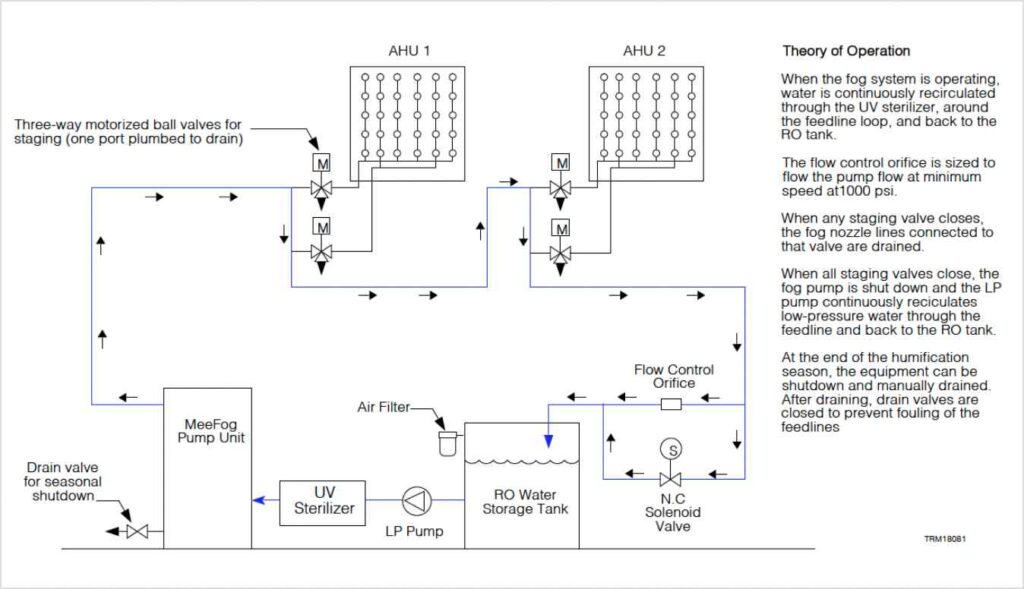
Modern humidification systems lower the risk through water purification and improved system design.
It doesn’t use untreated potable water as-is. The supply undergoes several stages to reach a high level of cleanliness. First, there is pre-treatment, where the incoming water is filtered using carbon filtration and, in some cases, softened to remove minerals and initial impurities.
Next, the water is forced through reverse osmosis (RO), removing dust particles, dissolved solids, and contaminants.
Before it even enters the humidification system, the water passes through two other steps: UV sterilization and submicron filtration. For adiabatic humidifiers in hospitals, this combination of RO, UV-C, and fine filtration is required to maintain optimal air quality at all times.
Modern humidification systems also keep treated water moving through the system. There are no stagnant reservoirs, and any sections not part of the active loop drain out when not in use.
This follows the same approach as in air-handling units. Excess water is removed as it forms, and components are arranged to guide moisture away to keep the ductwork clear.
The system also focuses on limiting areas where moisture can settle, since that’s where bacteria and other microorganisms can grow. This is especially important in a hospital humidifier, where stable conditions and clean air are required in critical environments.
This is how modern systems maintain controlled humidity while meeting ASHRAE 170 requirements.
| Feature | Steam Humidification | Adiabatic High-Pressure Fog |
|---|---|---|
| Energy Source | Gas-Fired Boilers | Electrically Powered System |
| Energy Use | High (Water Must Be Boiled) | Low (Energy Is Absorbed from The Surrounding Air) |
| Emissions | Direct Carbon Emissions | No Direct On-Site Emissions |
| Process | Generates Steam through Heat | Uses Ultra-Fine Mist That Evaporates in The Air |
| Added Effect | No Cooling Benefit | Provides An Evaporative Cooling Effect |
| Efficiency | Energy-Intensive | Significantly Lower Energy Demand |
Both systems can deliver the same humidity levels. The main difference is how much energy is used to get there.
Steam systems heat water in a boiler until it turns into steam, which is then added to the airstream. It’s a method that has been used for a long time in healthcare.
The drawback is the amount of energy required to keep water at boiling temperature. That energy usually comes from gas, which adds to operating costs and carbon emissions.
Adiabatic high-pressure fog systems work differently. Water is pressurized and released as a fine mist into the airstream.
As the droplets evaporate, they draw heat from the air, so there is no need to generate steam. They are more energy efficient and do not produce direct on-site emissions from fuel.
Hospitals looking to improve energy performance usually work on several areas at once. That can include more efficient fans, better building sealing, LED lighting, and energy recovery systems. Humidification falls into that same group.
Adiabatic systems help reduce the amount of energy needed to maintain proper humidity levels. In many cases, the difference between the steam and adiabatic energy used is huge, often described as up to 100:1.
These high-efficiency humidifiers also move energy use away from gas and toward electricity, which lowers direct carbon emissions. This supports sustainability efforts and can contribute to LEED goals.
Systems like MeeFog are designed with this approach, providing precise humidity control while keeping energy use lower. A cancer center in New York even paid back the MeeFog hospital-grade humidifier in under two years through energy savings.
Most systems fall within the 2- to 5-year range, depending on size and usage.
Many hospitals are still hesitant to move away from steam systems. Part of that is just what they’re used to, and part of it comes from how these systems are understood.
One common concern is that if you spray water into the airstream, you’ll automatically get contamination or bacterial growth. That comes up a lot, but it’s not always the case.
It really comes down to how the system is built and how the water is handled. The water is treated before it enters the system, and the system is set up so it doesn’t sit or collect anywhere.
Those are the same things hospitals already manage in air handling units today. When you control those parts, the risk is controlled as well.
These systems are designed to meet healthcare standards, so they’re already being used in hospital settings.
With modern humidification systems, hospitals can maintain proper humidity levels while supporting infection prevention and meeting international healthcare standards. They also use less energy, which is great for long-term sustainability.
However, performance still comes down to system design and how water and airflow are managed within the system. That’s why choosing the right humidifier for hospital use matters.
Learn how MeeFog’s compliant adiabatic humidification systems can help hospitals reduce risk and energy use while maintaining stable, controlled environments.