MeeFog Recognized as the Energy Infrastructure Solution of the Year
Restore gas turbine output and stabilize the power grid with MeeFog precision fogging. Learn how high-pressure evapo...
Existing Customers Call 626-359-4550 Or Visit Customer Care

TL;DR
Gas turbines lose efficiency in high temperatures due to reduced air density. MeeFog’s advanced fogging systems use high-pressure water injection to cool the air, increasing turbine output. This evaporative cooling and wet compression boost performance by up to 15%, with minimal risk of corrosion, as they use demineralized water. MeeFog’s systems are compatible with various gas turbine models worldwide and are backed by over 50 years of expertise and more than 10,000 installations. Routine maintenance and support services ensure long-term reliability and efficiency. MeeFog’s technology helps power plants improve efficiency, reduce energy costs, and enhance turbine performance under challenging conditions.
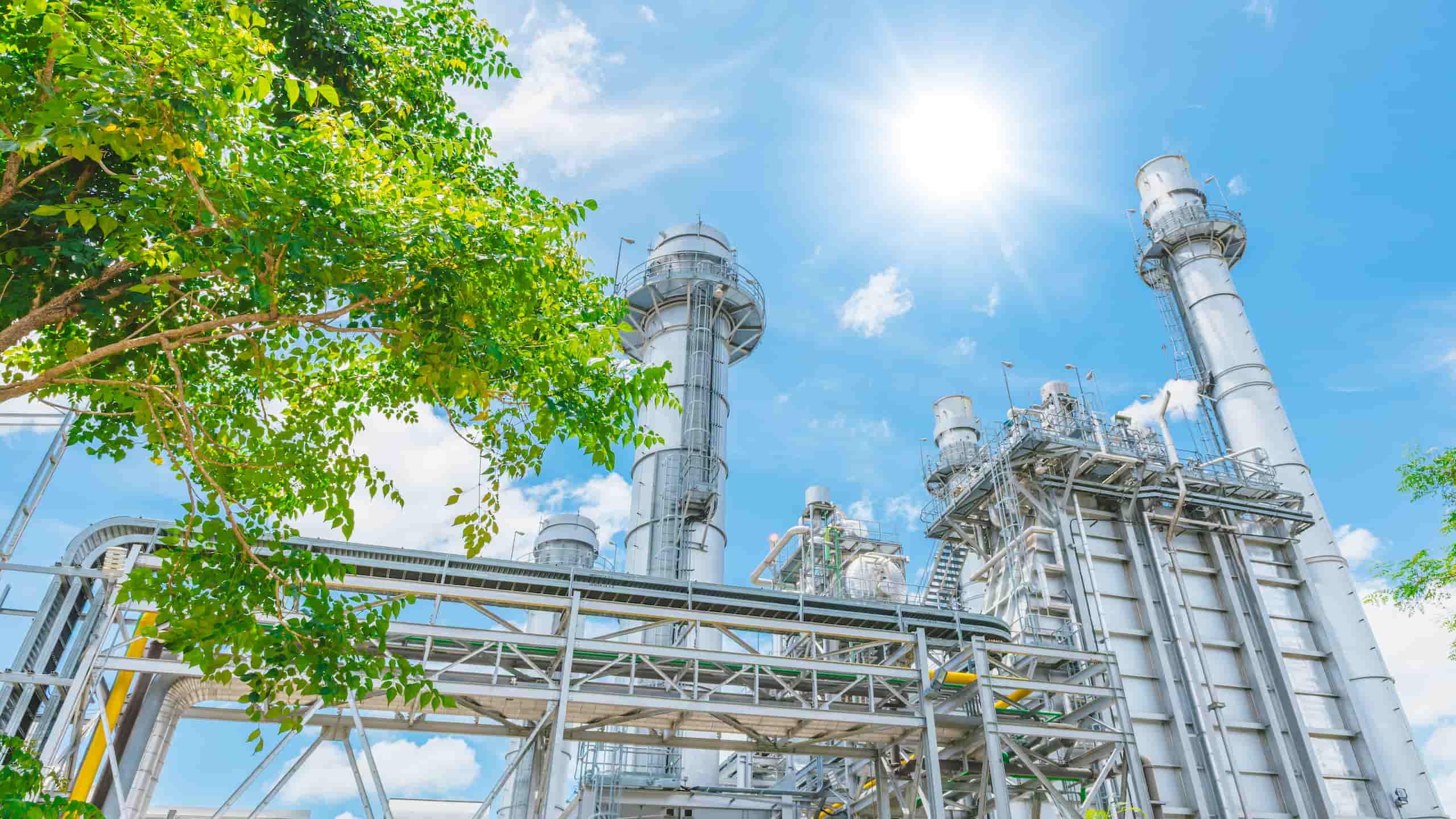
Power plants across the world face a common challenge: gas turbine efficiency decreases significantly as ambient temperature rises. During peak demand periods, typically the hottest days, operators see a drop in gas turbine output due to reduced air density. The solution lies in advanced fogging technology.
For over five decades, Mee Industries has led the global market in high-pressure fog systems, providing proven technology that boosts performance, reliability, and energy efficiency. With over 10,000 installations worldwide, the MeeFog system has demonstrated its ability to increase power output, stabilize turbine operation, and reduce energy production costs.
This post explains how fogging systems for gas turbines work, the performance benefits they deliver through evaporative cooling and wet compression, and a list of our installations worldwide.
Gas turbines are rated at ISO conditions (15°C/59°F and 60% relative humidity), but peak power demand typically occurs at much higher ambient temperatures. As temperatures rise to 105°F (40°C), air density drops, reducing mass flow and cutting turbine output by roughly 15-20%.
Installing a MeeFog system for gas turbines allows you to recover a significant part of the lost output by injecting high-pressure demineralized water into the inlet air supply to the gas turbine. This water evaporates quickly and cools the air. Cooler air is denser, so the output of the gas turbine is increased.
Many facilities have recovered a significant portion of lost output with fog cooling. Using a MeeFog system for gas turbines, a Sahara Power Station managed to improve the output of the gas turbines by as much as 15%, while using half the water that water injection in the combustor would require.
Fogging relies on the fast evaporation of fine water droplets. When the fogging system injects water into the air stream, heat from the air is absorbed by the droplets. As they evaporate, the surrounding air cools rapidly: this is direct, efficient evaporative cooling. Only demineralized water is used to avoid fouling, scaling, or corrosion, a non-negotiable for long-term operation.
While air inlet fogging delivers strong results, some facilities need even greater power and flexibility. MeeFog fogging systems can also operate in a wet compression mode (also known as overspray or intercooling). Here, water droplets are added in amounts beyond what the ambient air can absorb before the compressor. This “overspray” finds a different path to higher performance.
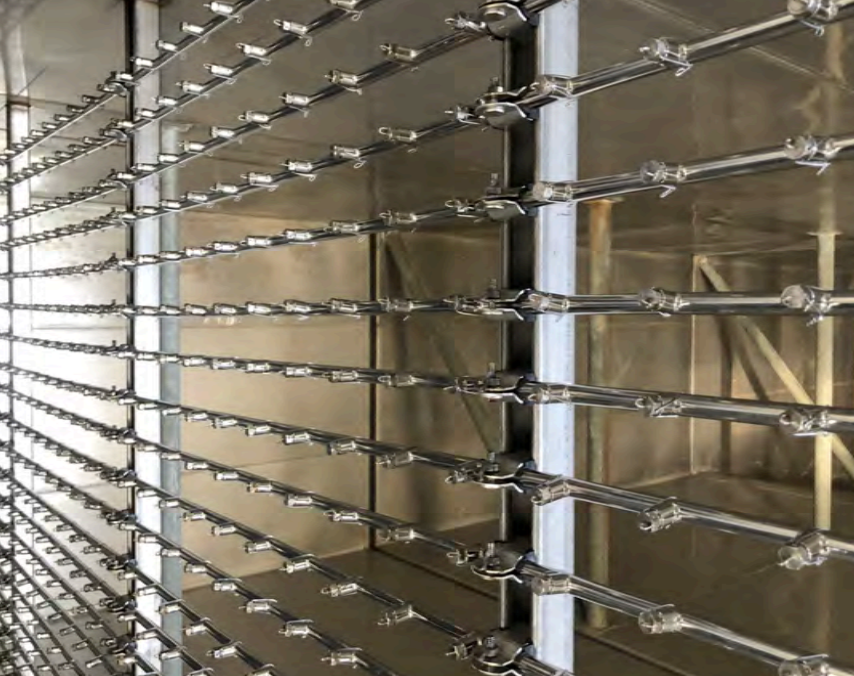
Gas turbine wet compression operates best when the control system tightly manages flow rates based on ambient conditions. Outlet temperature, humidity, and compressor design all affect how much additional water may be safely and effectively added. Mee Industries has developed proprietary controls and advanced impaction-pin nozzle technology to deliver reliable, erosion-free operation with these demanding configurations.
Over 50 years of active research and field experience have shaped the current MeeFog fogging system for gas turbines. We build every system with the “most important thing” in mind: safe, efficient power improvement that lasts.
System Integration and Maintenance
Careful system integration is necessary. Placement of manifolds, droplet trajectory, control logic, and feedback from turbine instrumentation all keep your fogging system working safely and efficiently. Routine maintenance involves verifying filter state, checking pump performance, inspecting nozzles, and reviewing water purity logs.
Your fogging system’s long life and performance hinge on attention to detail beyond initial installation. Since the company’s start, Mee Industries has made comprehensive support a core value. We commit not just to the system, but to client education and operational confidence.
Support services include:
MeeFog technology is compatible with all major gas turbine OEMs. Since launching our first gas turbine fogging system in 1994, we have covered over 1,200 installations and 90 gigawatts (GW) in operating capacity. This includes large and small power plants, industrial cogeneration, and grid-balancing peaking stations across the United States and internationally. Our compatibility extends to:
The following table provides an overview of MeeFog installations for gas turbines worldwide, focusing on different OEMs, locations, and operational environments.
| Name of Unit | Megawatt & Unit No. | Location | Customer | Commission Date |
|---|---|---|---|---|
| Siemens SGT5-8000H | 302 MW (2 units) | South Bangkok Power Plant, Bangkok, Thailand | Electricity Generating Authority of Thailand (EGAT) | 2023 |
| Pratt & Whitney FT4 | 238.4 MW (4 units) | Decker Creek Power Station, Austin, Texas, USA | Austin Energy | 2024 |
| Mitsubishi Power MHPS M701S (DA) X-Series | 125 MW (1 unit) | Bao Steel Corp #2, Inner Mongolia, China | Baotou Iron and Steel (Group) Co., Ltd. (Baogang Group) | 2024 |
| Mitsubishi Power M501F | 180 MW (2 units) | Southern California Refinery, Mexico | CCC Tuxpan / Refinery | 2024 |
| Alstom GT24 | 188 MW (10 units) | Midlothian and Hays Energy Plants, Texas, USA | Vistra Energy | 2020 |
| Mitsubishi M501J | 320 MW (6 units) | Himeji Daini Power Station, Himeji, Japan | Kansai Electric Power Co. | 2012-2013 |
| Alstom GT26 | 277 MW (1 unit) | JFE Steel East Japan Works, Chiba, Japan | JFE Steel Corporation | 2015 |
| Alstom GT13E2 (High Ambient) | 165 MW (4 units) | ALBA Aluminium Bahrain, Manama, Bahrain | Aluminium Bahrain (ALBA) | 2011-2014 |
| Siemens SGT-800 | 220 MW (1 unit) | TE-TO AD Skopje, Skopje, North Macedonia | TE-TO AD Skopje | 2023 |
| Siemens V94.2 | 149 MW (2 units) | Phu My 2.1 Power Plant, Phu My, Vietnam | EVN / Alstom | 2006 |
| GE 7FB.04 | 200 MW (2 units) | Fox Energy Center, Kaukauna, Wisconsin, USA | Fox Energy Center | 2018 |
| GE 7EA | 85 MW (16 units) | Lincoln Combustion Turbines, Stanley, North Carolina, USA | Duke Energy | 2000 |
| GE 7EA | 85 MW (1 unit) | Linden Cogeneration Plant, Linden, New Jersey, USA | Linden Cogeneration | 2020 |
| Westinghouse W501 (W-Class) | 158 MW (2 units) | Sioux Falls, South Dakota, USA | Northern States Power (Xcel Energy) | 2000 |
| Alstom GT11N | 90 MW (4 units) | Concord Generating Station, Watertown, Wisconsin, USA | We Energies | 2023 |
| GE LM6000 Sprint | 48 MW (1 unit) | Apizaco Cogeneration Plant, Apizaco, Mexico | Procter & Gamble | 2006 |
| GE LM5000 | 102 MW (3 units) | Williams EMT Gas & Power, Pennsylvania, USA | Williams Companies | 2002 |
| Rolls-Royce RB211 (Offshore) | 29 MW (1 unit) | Offshore Platform, Dubai, UAE | Dubai Petroleum | 2003 |
| Mitsubishi Power H-25 Series | 27 MW (1 unit) | LG Chem Yeosu Plant (Whachi Complex), Yeosu, South Korea | LG Chemical Ltd. | 2015 |
| GE 5371PA | 26 MW (12 units) | Hallett Power Station, Hallett, Australia | EnergyAustralia | 2009 |
| Siemens V64.3 | 62 MW (2 units) | Amata-EGCO Power Plant, Chonburi, Thailand | Amata-EGCO | 2002 |
| GE 6561B (6B) | 40 MW (2 units) | Thai National Power Plant, Rayong, Thailand | Thai National Power | 2002 |
| GE 7EA (Wet Compression) | 85 MW (2 units) | Harry Allen Generating Station, Moapa, Nevada, USA | NV Energy | 2021 |
OEM Matrix / Reference Installations MeeFog Gas Turbine Installations by OEM and Frame Designation
| OEM | Model/Frame | No. of Turbines |
|---|---|---|
| General Electric (GE) | 6B | 123 |
| General Electric (GE) | 6B.03 | 2 |
| General Electric (GE) | 6F.01 | 5 |
| General Electric (GE) | 7B | 29 |
| General Electric (GE) | 7E | 27 |
| General Electric (GE) | 7E.03 | 210 |
| General Electric (GE) | 7F | 17 |
| General Electric (GE) | 7F.03 | 78 |
| General Electric (GE) | 7F.04 | 2 |
| General Electric (GE) | 7FA | 4 |
| General Electric (GE) | 7HA.02 | 2 |
| General Electric (GE) | 9E | 47 |
| General Electric (GE) | 9E.03 | 23 |
| General Electric (GE) | 9F.03 | 2 |
| General Electric (GE) | 9F.04 | 1 |
| General Electric (GE) | Frame 3 | 1 |
| General Electric (GE) | Frame 5 | 93 |
| General Electric (GE) | LM 6000 Sprint | 1 |
| General Electric (GE) | LM 6000PC | 2 |
| General Electric (GE) | LM 6000PD | 1 |
| General Electric (GE) | LM2500 | 7 |
| General Electric (GE) | LM2500+ | 3 |
| General Electric (GE) | LM2500+(PK) | 1 |
| General Electric (GE) | LM5000 | 5 |
| General Electric (GE) | LM6000 | 16 |
| General Electric (GE) | LM6000PC | 3 |
| General Electric (GE) | LM6000PD | 1 |
| General Electric (GE) | LM6000PF | 1 |
| General Electric (GE) | MS6001 | 2 |
| General Electric (GE) | MS6001B | 2 |
| General Electric (GE) | total: | 711 |
| Siemens Energy | FT4 | 37 |
| Siemens Energy | FT8 | 1 |
| Siemens Energy | FT8 PowerPac | 28 |
| Siemens Energy | FT8 PowerPack | 8 |
| Siemens Energy | FT8 SWIFTPAC | 2 |
| Siemens Energy | FT8 Twin Pac | 16 |
| Siemens Energy | GT10B | 6 |
| Siemens Energy | GT11D5 | 4 |
| Siemens Energy | GT11N | 33 |
| Siemens Energy | GT11N2 | 3 |
| Siemens Energy | GT13D | 3 |
| Siemens Energy | GT13E | 2 |
| Siemens Energy | GT13E2 | 13 |
| Siemens Energy | GT24 | 17 |
| Siemens Energy | GT26 | 5 |
| Siemens Energy | GT8C | 3 |
| Siemens Energy | SGT-1000 | 3 |
| Siemens Energy | SGT-1000F | 7 |
| Siemens Energy | SGT-200 | 4 |
| Siemens Energy | SGT-A20 | 4 |
| Siemens Energy | SGT5-2000E | 11 |
| Siemens Energy | SGT5-4000F | 1 |
| Siemens Energy | SGT5-8000H | 2 |
| Siemens Energy | SGT6-2000E | 7 |
| Siemens Energy | SGT6-3000E | 10 |
| Siemens Energy | SGT6-5000F | 14 |
| Siemens Energy | W101 | 3 |
| Siemens Energy | W191 | 1 |
| Siemens Energy | W251 | 8 |
| Siemens Energy | W501 | 12 |
| Siemens Energy | W501B | 7 |
| Siemens Energy | total: | 275 |
| Mitsubishi Power | H-25 | 2 |
| Mitsubishi Power | M501D | 1 |
| Mitsubishi Power | M501F | 9 |
| Mitsubishi Power | M501G | 9 |
| Mitsubishi Power | M501J | 6 |
| Mitsubishi Power | M501SDA | 4 |
| Mitsubishi Power | M701ADS | 1 |
| Mitsubishi Power | M701DS | 2 |
| Mitsubishi Power | M701F | 10 |
| Mitsubishi Power | M701S | 2 |
| Mitsubishi Power | M7A-02D | 1 |
| Mitsubishi Power | MF-111 AB | 1 |
| Mitsubishi Power | MHI 251S | 6 |
| Mitsubishi Power | total: | 50 |
| Rolls-Royce | Rolls-Royce Avon | 15 |
| Rolls-Royce | Allison 501-KB7 | 1 |
| Rolls-Royce | Rolls-Royce Avon MK1535 | 2 |
| Rolls-Royce | Rolls-Royce RB211 | 6 |
| Rolls-Royce | Rolls-Royce RB211-6562DLE | 1 |
| Rolls-Royce | Rolls-Royce SK30 | 1 |
| Rolls-Royce | total: | 26 |
| Other Manufacturers | total: | 118 |
| total installations as of 2025 | 1180 | |
Note: Some turbine designations reflect legacy manufacturer naming conventions or regional variants. For frame-specific performance data or retrofit feasibility, contact us.
Contact Details:
Mee Industries, Inc.
16021 Adelante Street,
Irwindale, California 91702
info@meefog.com
Toll Free
+1.800.732.5364
+1.626.359.4550
International
+1.626.359.4550
Fax
+1.626.359.4660
Reliable cooling and performance optimization define successful turbine operations. A MeeFog fogging system gives operators a direct path to increase gas turbine power output, improve thermal efficiency, and reduce heat rate penalties under high ambient conditions.
Each component, from the precision-engineered stainless-steel nozzles to the high-pressure pump skid, is developed for endurance in the toughest environments. Most importantly, we support every project from system design through long-term maintenance, helping you achieve consistent power supply and reliable performance.
If you are overseeing an energy, manufacturing, or large facility project and want to improve gas turbine performance, review your site’s ambient data and consider a gas turbine fogging system by MeeFog.
Request a quote now or contact our experts to learn more about our gas turbine fogging systems.