MOCA Los Angeles Enhances Art Preservation with MeeFog Humidification
Case Study: MOCA L.A. upgraded AHUs with a new MeeFog humidification system and building automation system to......
Existing Customers Call 626-359-4550 Or Visit Customer Care

TL;DR
Amherst College reduced cooling demand and energy use in its Science Center by adding a MeeFog high-pressure fogging system. The system improved heat recovery, lowered chiller load, provided strong energy savings, and offered a fast return on investment.
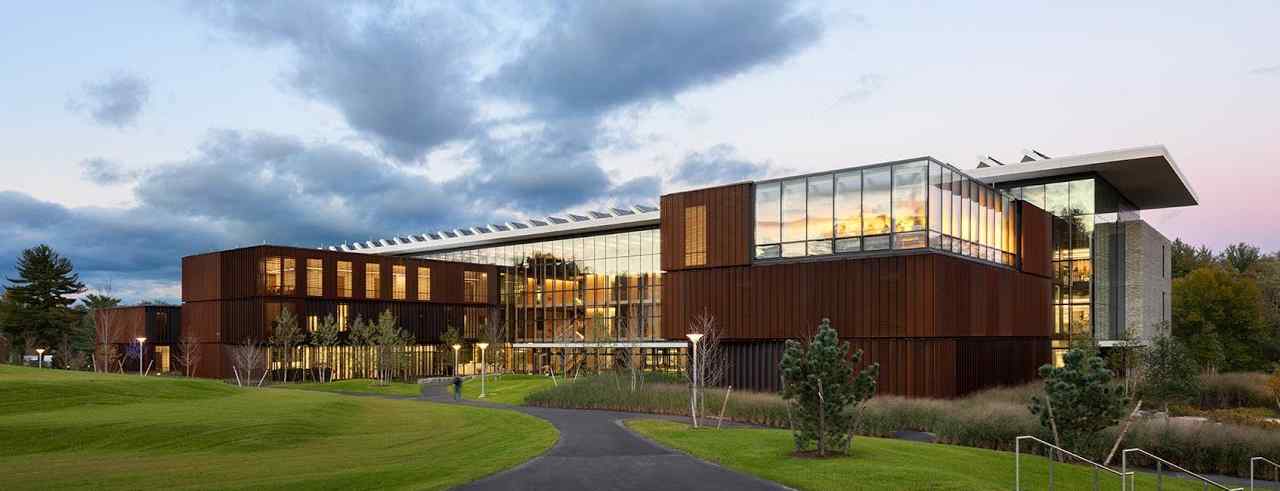
Amherst College built a new Science Center to support growing STEM programs and improve energy performance. The facility uses advanced HVAC systems, renewable energy, and a high-pressure fogging system to reduce cooling demand.
The project reduced energy usage by 73% compared to a typical science building. The addition of fog-based cooling (designed and installed by MeeFog) improved heat recovery efficiency and lowered operating costs across the facility.
Amherst College is a liberal arts institution founded in 1821. It has seen an 85% increase in enrollments in Science, Technology, Engineering, and Math (STEM) classes during the past 15 years. Consequently, a new Science Center was opened in the fall of 2018, which focuses on sustainability, efficiency, and reduced carbon emissions.
The new science building comes with:
Additional solar energy comes from the Farmington Solar project in Maine via a 20-year power purchase agreement (PPA) for 10,000 megawatt hours (MWh) of electricity. This PPA cuts carbon emissions by 3,200 metric tons per year and greenhouse gas emissions by 17.5%. The rest of the needed power (about half) is derived from a combined heat and power (CHP) plant on campus, which is to be gradually phased out.
“Deriving such a significant amount of Amherst’s electrical needs from this renewable source represents a major step in the College’s Climate Action Plan (CAP),” said James Brassord, chief of campus operations. “This electricity will be used to power the infrastructure that will allow us to decarbonize the campus.”
The Science Center labs require constant fresh air with no recirculation. This creates a high cooling demand, especially during summer.
Hot outside air increases the load on the central chiller plant. This leads to higher energy use and operating costs. The system needed a way to reduce this cooling demand while maintaining strict lab conditions.
MeeFog installed a high-pressure fogging system to support both humidification and evaporative cooling in the Science Center. The system precools exhaust air before it enters the heat recovery loop, significantly enhancing energy efficiency.
The system uses ultra-fine droplets, generated by high-pressure pumps and stainless steel nozzles. These droplets evaporate rapidly, lowering the air temperature and improving heat exchange performance.
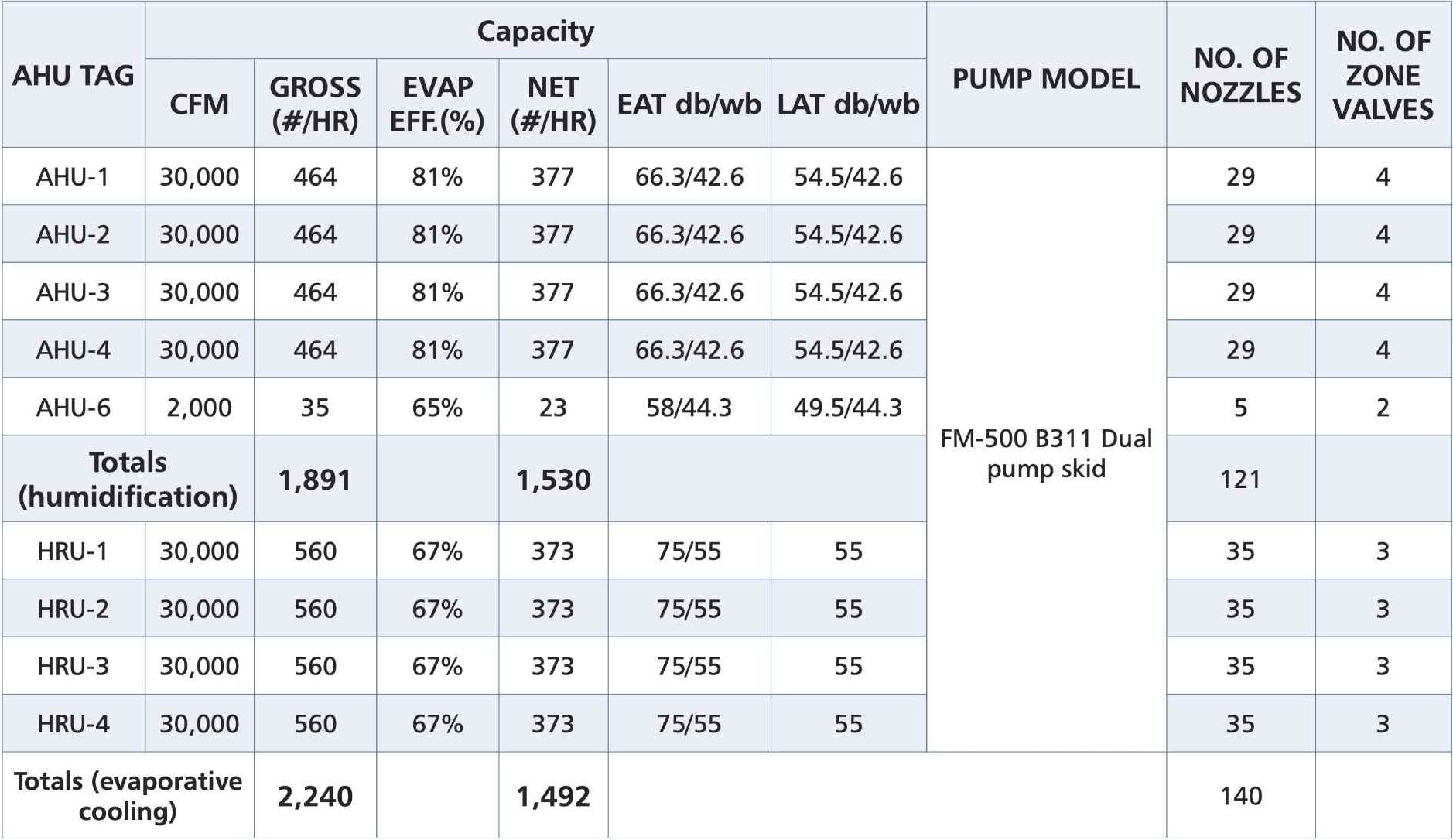
The setup includes staging valves to precisely control fog output based on temperature conditions, providing consistent performance throughout the summer. Specifically, the fogging system supports five air handling units (AHUs) and four heat recovery units (HRUs).
The system features a pump rack with dual 5 GPM pump units, 5 HP motors, VFD, and pressure transducers. The pumps are mounted on a stainless steel rack with a single-point power connection and a PLC that monitors both pump units, providing automatic switchover as needed.
| Project Conditions | Fog System Design |
|---|---|
| Entering air conditions: 66 °F db / 44° F wb | Humidification |
| Leaving air conditions: 55° F db / 42° F wb | MeeFog Nozzle Count: 121 Humidification capacity: 1,530 #/hr |
| MeeFog’s Scope of Work
Supply of fog pump rack, staging valves, nozzle manifolds, and mist eliminators. Max fog system power: 2 x 5 HP |
Evaporative Cooling
MeeFog Nozzle Count: 140 |
When designing the high-pressure fogging system, MeeFog installed fog nozzle arrays in the exhaust air stream before the glycol run-around loop. The system injects fine fog into the exhaust air to reduce its temperature before heat exchange.
This step increases the effectiveness of the heat recovery system. The system adjusts output through staging valves as temperatures rise. It keeps performance consistent, especially during summer when outdoor temperatures are through the roof.
Amherst College faced high cooling demands in its Science Center due to regulations requiring a constant fresh air supply. The fogging system helps reduce energy costs by cooling the exhaust air before it reaches the run-around coil, lowering the workload on the chiller plant by one third and cutting carbon emissions.
The combination of a glycol loop and fog-based cooling of exhaust air slashes cost by about one third with a corresponding reduction in the carbon footprint,”
Van Zelm Engineers designed a glycol run-around loop that efficiently transfers heat between exhaust and supply air. This closed-loop system, combined with the fogging system, improves energy recovery efficiency.
The system’s optimization software adjusts its performance based on seasonal changes to maximize energy recovery, achieving up to 70% recovery, a significant improvement over traditional methods.
“The typical run-around loop can perhaps reach 55% energy recovery, whereas Konvekta can reach 70% and beyond due to its built-in intelligence,” said Fontaine of van Zelm, who works as project manager for the Science Center project.
MeeFog cools exhaust air by 10–15°F through the evaporation of microfine fog droplets before it enters the glycol loop. This boosts energy recovery by improving the temperature differential between exhaust and intake air, reducing the load on centrifugal chillers. The fogging system’s water atomization ensures maximum cooling while using minimal water.
Amherst’s Science Center upgraded its cooling system with a combination of glycol and fog-based cooling. The MeeFog system improved peak heat recovery efficiency by 50% and boosted annual recovered cooling energy by over 400%. In 2021 and 2022, the total cooling recovery increased from 885 MM Btu to 1,119 MM Btu, saving 800 MM Btu annually.
Van Zelm Engineers suggested extending fogging use beyond winter humidification to include summer cooling for better financial returns. In facilities like labs and hospitals, adding fogging to energy recovery systems can lower energy use and pay for itself in a few years.
“If you are already using fog for humidification in winter, all you have to do is get some extra piping for summer, and you reduce your first costs and greatly increase the financial picture,” said Fontaine.
The fog system reduces chiller load by up to 80 tons per day during summer. With both the glycol loop and fogging in operation, Amherst College saw a reduction of 36,000 tons in chiller cooling annually, resulting in significant savings on energy bills and further reducing the carbon footprint.
In winter, fogging maintains necessary humidity levels in labs to prevent static electricity damage. This system’s versatility extends beyond cooling, contributing to year-round building performance, with plans to replace steam-based humidification systems in other campus buildings as part of the college’s climate action plan (CAP).
If the building already has a glycol loop energy recovery system, payback occurs within one cooling season in New England. Without it, the payback timeline may be longer.
MeeFog brings proven expertise and reliable performance to high-demand environments, like science centers and research labs.
Mee Industries has over five decades of experience in high-pressure fogging systems. This experience supports reliable system design and consistent performance.
More than 10,000 systems operate globally across campuses, labs, and industrial facilities. These installations show consistent results in energy savings and performance improvement.
MeeFog systems use ultra-fine droplets and precise controls to deliver efficient cooling and humidification. This technology supports performance and cost savings.
The Amherst Science Building Project shows how a high-pressure fogging system can reduce cooling demand and improve efficiency in high-ventilation buildings. If your facility faces high cooling costs, MeeFog can help you improve performance and lower energy use. Explore how fog-based cooling can support your HVAC goals.
For more on the project, download the case study.
If you need help with your next project, request a quote immediately.