Evaporative Cooling for Data Centers: How Fog-Based Cooling Improves Efficiency and Reduces Energy Use
Cooling prevents overheating of servers, processors, and power systems in data centers so they can maintain high......
Existing Customers Call 626-359-4550 Or Visit Customer Care

TL;DR
Fog humidification helps manufacturing facilities maintain precise humidity levels that directly impact product quality, equipment reliability, and worker comfort. By stabilizing moisture-sensitive materials, it reduces defects, scrap, and production downtime. Proper humidity control also minimizes static electricity, protecting products, operators, and sensitive electronics. Cleaner air with reduced dust buildup extends the lifespan of equipment and sensors. Employees benefit from improved comfort and focus, which supports higher productivity and fewer errors. Fog systems provide adiabatic cooling, lowering HVAC loads and reducing energy costs. Advanced systems respond quickly to environmental changes, improving process precision in applications like printing and coating. Overall, fog humidification supports efficient, cost-effective, and sustainable manufacturing operations.
Managing air quality, humidity, and temperature inside a manufacturing facility is a challenge that impacts everything from product quality to equipment reliability. Many industrial facilities in the United States now look for smarter environmental controls because even small changes can give measurable gains.
According to a recent Siemens study, unplanned downtime costs the world’s 500 biggest companies 11% of their revenues, which totals $1.4 trillion. Issues linked to static discharge, material brittleness, or even equipment faults are usually tied to humidity that drifts outside the needed range. Fog humidification offers a precise way to address these losses, providing consistent environmental control year-round.
Let’s check out a few key ways a fog humidification system can boost efficiency across your manufacturing facility.
Many materials, such as paper, textile fibres, wood, plastics, and electronic components, respond to air moisture. When humidity is too low, these materials dry out, warp, or lose flexibility. When it’s too high, they can absorb moisture unevenly, leading to jams, wrinkles, or dimensional changes.
A MeeFog humidification system helps you maintain a steady humidity profile throughout the facility. Controlled moisture levels prevent defects, which means fewer shutdowns and reworking of product batches. The result is consistent quality and reduced scrap rates.
The MeeFog fog humidification system has proven effective in maintaining the relative humidity (RH) at 45% inside Dixie Consumer Products LLC’s Lexington, Kentucky, manufacturing plant. Installing this system has helped them boost production by enabling distortion-free molding. It also offers zone-specific control for optimal production efficiency.
Low humidity usually leads to static buildup. In manufacturing environments that handle film, paper, or electronics, static charges can cause sparks and product damage. Operators can experience discomfort or even safety concerns from repeated discharges.
By using a fog humidification system, you can keep the air conductive enough to dissipate static charges safely. A balanced environment prevents static issues without the need for extra antistatic sprays or ionizing equipment.
Dust and airborne particles are more likely to stay suspended when the air is dry. This buildup can harm sensors, lenses, conveyors, and electronic components. Higher humidity allows fine particles to settle more quickly, reducing contamination problems.
A fog humidification system introduces micro-fine water droplets that combine with dust, making it easier for the facility’s air filters to capture. Cleaner air extends the lifespan of precision instruments and ventilation systems, keeping your processes accurate and reliable.
Operators working long shifts in dry air experience irritation in the eyes, throat, and skin. Static shocks on metal surfaces or control panels also make conditions unpleasant. Reduced comfort can slow your production and increase fatigue.
MeeFog humidification technology produces a more comfortable climate by raising relative humidity to optimal levels. Balanced humidity not only reduces discomfort but can also improve focus, energy, and precision in manual tasks, contributing to overall workplace productivity.
Magnets USA used a fog humidification system designed by MeeFog to maintain employee comfort. This system has led to significant improvements in product quality and manufacturing processes. In addition to this, they also saw a considerable reduction in maintenance costs and energy usage.
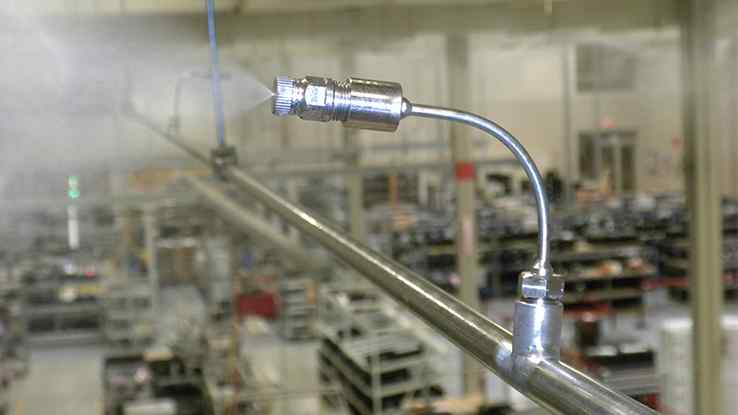
Fog humidification works on an adiabatic principle: water droplets absorb heat as they evaporate, cooling the air without additional refrigeration. This effect can lower ambient temperature across the production floor, reducing the cooling load on HVAC systems.
By implementing a fog humidification system, manufacturers gain both humidity control and efficient cooling in one process. This dual function minimizes energy consumption while maintaining equipment-friendly conditions, particularly in hot or densely populated production spaces.
Connor-Winfield, the fastest-growing timing products supplier in North America, installed a MeeFog humidification system to save costs on energy and maintenance. The system uses a single high-pressure MeeFog pump delivering 1000 psi water to the nozzle headers via staging solenoids. After installing this fog humidification system, they managed to save over $35,000 annually on energy costs and an additional $3,000 per year on maintenance.
Processes such as coating, printing, and component assembly require precise humidity control. Even a slight deviation can lead to poor adhesion, inconsistent drying, or mechanical misalignment.
MeeFog humidification systems respond rapidly to humidity fluctuations. Integrated sensors and high-pressure pumps adjust water flow, preventing sudden changes that could affect product quality. Consistent environmental conditions mean fewer adjustments, shorter cycle times, and smoother operations.
Water usage and energy efficiency are central concerns in any industrial upgrade. A modern fog humidification system uses minimal water because it converts each droplet directly into vapor without heating. There’s no excess drain or condensate, making it both efficient and environmentally responsible.
MeeFog humidification designs also reduce reliance on traditional steam systems, cutting energy demand and emissions. Manufacturers gain sustainability benefits while reducing operational expenses, helping your facilities meet modern environmental targets without compromising performance.
Consistent humidity control supports every part of a manufacturing facility: materials stay stable, workers stay comfortable, and machinery stays reliable. Investing in a fog humidification system is not only about maintaining air moisture. It’s about protecting efficiency, product consistency, and energy savings.
Ready to Optimize Your Facility’s Climate? MeeFog has spent over 50 years perfecting humidity and cooling solutions for industries worldwide. With thousands of systems installed globally, we can help you design a setup that fits your production requirements precisely.
Call our toll-free number 1.800.732.5364 or reach out online to see how we can help boost your facility’s performance.
1. How does fog humidification differ from traditional steam humidification?
Fog humidification uses high-pressure water instead of steam to control humidity. It consumes less energy and provides adiabatic cooling, making it a more efficient choice for most industrial applications.
2. Is fog humidification safe for electronics and sensitive machinery?
Yes, a fog humidification system produces ultra-fine droplets that evaporate instantly, avoiding wet surfaces or condensation near critical components.
3. Can a MeeFog system integrate with existing HVAC equipment?
MeeFog humidification systems are designed for easy integration with new or existing ventilation frameworks, central air handlers, and standalone zones.
4. How much maintenance does a fog humidification system require?
Maintenance is minimal. Regular checks on nozzles and filters keep performance optimal. With proper water treatment and scheduled service, many systems operate for years with few issues.
5. What type of water quality is needed for fog humidifiers?
Deionized or reverse osmosis–treated water is recommended. Clean water prevents mineral deposits and maintains nozzle precision for long-term operation.
6. Which industries benefit most from fog humidification?
Manufacturers handling paper, textiles, electronics, plastics, and food products gain the most. Each of these environments needs humidity stability to maintain quality and efficiency.