Another O&G Innovation Improving the Environment | OGGN Podcast Ep 249
Listen: Thomas Mee, CEO of Mee Industries discusses how fog can act as a bridge between traditional......
Existing Customers Call 626-359-4550 Or Visit Customer Care

Cooling prevents overheating of servers, processors, and power systems in data centers so they can maintain high uptime and stay reliable under heavy, continuous operation.
Large data centers mainly use air cooling systems such as computer room air handlers (CRAH), chillers, and outdoor heat exchangers to remove heat from the facility. But as rising heat loads and energy costs increase system demand, they must operate longer and at higher capacity, driving up power consumption.
Evaporative cooling is becoming a practical way to improve efficiency under these conditions.
In this article, we look at how evaporative cooling works, what influences its effectiveness, and how it is applied in data center environments.
Evaporative cooling is a natural process of cooling an airflow using liquid water. It is effective for heat rejection because evaporation requires a large amount of heat energy.
As water vaporizes, it draws that heat from the air, allowing significant thermal energy to be removed with minimal electrical input.
When applied alongside mechanical cooling systems, evaporative cooling can reduce chiller energy consumption and runtime in data centers. It can carry a substantial portion of the heat rejection load using primarily fans and pumps, especially during dry and favorable weather conditions.
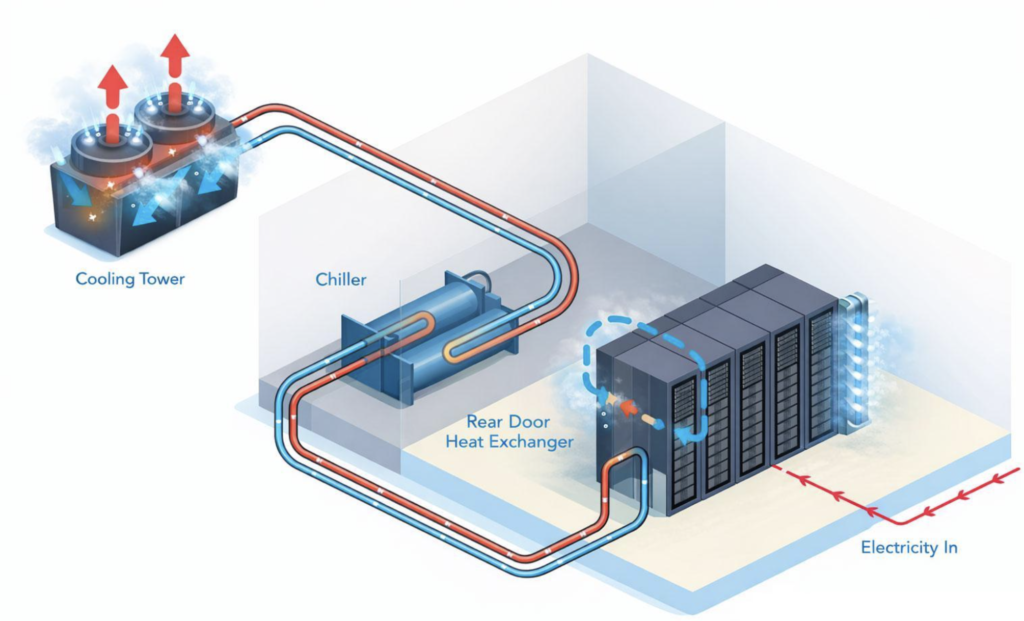
Servers generate heat as they process, store, and network data. That heat is commonly removed by air moving through the racks and, in high-density systems, by a liquid cooling loop that absorbs it directly from the chips and transfers it to a secondary facility water loop.
The heated fluid is then routed to a chiller or to an outdoor heat exchanger to release the accumulated thermal energy to the atmosphere. Once cooled, the water returns to the data center and continues the cycle.
The amount of heat an outdoor exchanger can reject depends on the temperature difference between the water inside the coil and the outdoor air. As outdoor temperature rises, the heat exchanger transfers less heat at the same airflow and surface area. So, compressors and fans operate longer to maintain design conditions.
MeeFog systems can be installed on the air side of the outdoor heat exchanger. A fine spray is introduced upstream of the coil. As the droplets evaporate, the entering air temperature decreases before it passes over the heat-transfer surface.
With cooler air entering the coil, the temperature differential between the process fluid and the air increases. Heat transfer improves, particularly during periods of elevated outdoor temperature.
In addition to heat-exchanger pre-cooling, the system can be applied for:
OneNeck IT Solutions’ data center in Wisconsin replaced its electric steam humidifiers with a high-pressure MeeFog system installed in the air handling units.
Steam introduces sensible heat into the supply air, whereas evaporating fog lowers air temperature as it absorbs heat. The cooler supply air reduced the load on the facility’s chilling coils, decreasing mechanical cooling demand.
Surface area and droplet size affect evaporation rate and efficiency.
Smaller droplets expose more surface for the same amount of water. Since droplets are spherical, if the droplet diameter doubles, there is only half as much exposed surface area per unit of water, so the evaporation rate is cut in half.
For example, a 20-micron droplet has eight times more water mass than a 10-micron droplet. However, its surface area only increases by four times. Therefore, breaking that water into smaller droplets exposes much more surface area of water to the air, and evaporation occurs faster.
Airflow also affects evaporative cooling. Larger droplets tend to fall to the ground, so they don’t contribute as much to the evaporative cooling process. However, smaller droplets move with the air itself until they fully evaporate.
There is not usually enough time for all the fog spray to evaporate before the airflow reaches the condenser coil. If the flow per nozzle is high, the droplet size will be large, and the condenser coil can be over-wetted, resulting in water raining back to the ground.
Droplets that rain back accumulate as puddles on the ground and are lost to the evaporative cooling process. Since the coils are wetted, it’s important to treat the water to avoid the accumulation of mineral salts on the coils. More on this subject below.
In a hot and dry environment, more water can evaporate, which means a lower temperature can be reached.
For example, in the desert, the evaporative cooling system can reduce air temperature from 120°F down to 65 or 70°F, approaching the wet-bulb temperature.
However, in topical environments, like South Louisiana or Florida, the same process may cool air from 95°F to around 80°F. The air already contains more moisture, which limits how much additional water can evaporate.
Even with that, modern data centers still gain from evaporative cooling. A 5-10°F reduction allows them to design a smaller heat exchanger. The equipment does not have to work as hard to maintain design conditions. In some cases, the same cooling capacity can be achieved with less mechanical load, which can save a lot of electricity.
MeeFog systems interface very easily with existing HVAC controls. The building automation system (BAS) can send an enable or disable signal, and the fog system can operate based on ambient temperature, or it can decide when to turn the fog on and off based on temperature or operating conditions.
Automation can be as simple as an on/off command, or it can follow schedules and weather-based controls. For example, the BAS may allow fogging only when outdoor temperature and humidity indicate that evaporative cooling will be effective.
In some cases, a dedicated PLC can be used on the fog system to make those decisions. PLC logic monitors input signals such as temperature and humidity sensors and then controls outputs such as pumps and valves.
This allows the fog system to respond automatically to changing conditions and operate only when it provides a benefit.
Over-humidification is not typically a safety concern in outdoor cooling, but if too much water is sprayed on a humid day, water can collect on the coil and drip onto the ground. This won’t result in equipment damage; it’s just a waste of water.
The primary issue is overspraying. To prevent that, having weather-based control can determine temperature and humidity and help decide how much evaporative cooling is needed at the moment. Fog output is then staged on/off so the air is cooled without wasting water.
Liquid cooling removes heat directly at the server or rack level. Water, water glycol, or special dielectric fluids absorb heat from the chips and carry it into a facility’s water loop. That heat still has to be rejected outdoors, usually either directly through large air-cooled heat exchangers or dry coolers, or by chilling the water and pumping the heat to an outdoor chiller condenser.
Fog cooling is applied at the outdoor heat rejection heat exchanger. Fog evaporative cooling is typically installed on large air-cooled heat exchangers. A fine spray is introduced upstream of the coil. As the droplets evaporate, the entering air temperature drops. The lower air temperature increases the temperature difference across the coil, so more heat is removed.
Evaporative cooling pads can also be used. These systems rely on corrugated, wetted media through which air passes. The air cools as it moves across the wet surface.
On very large air-cooled heat exchangers, however, pad systems become difficult to apply. The structures are extensive, and the airflow areas are wide. Wetted-media type evaporative coolers also restrict airflow, which reduces cooling, and it can be difficult to control the amount of cooling they provide and, therefore, the amount of water they use.
Fog systems impose a negligible restriction on the airflow, and banks of nozzle lines can be turned on/off so the amount of cooling and water usage can be controlled.
Adding large media walls in front of existing coil banks is often impractical. In contrast, a high-pressure fog system can be installed without enclosing the entire heat exchanger.
Chillers are energy-intensive because they rely on compressors to move heat from the facility’s water loop to the outside air.
That mechanical compression process requires substantial electrical power, especially during hot weather when outdoor air temperatures are high.
Fog cooling improves that condition by cooling the air entering the condenser or outdoor heat exchanger. When the entering air temperature is reduced, the condenser operates at a lower temperature and pressure, which can save large amounts of energy, and a smaller chiller with a smaller condenser can meet the cooling requirement.
In many installations, condenser fogging can reduce chiller energy consumption by 20-30% during peak conditions.
Operation can also vary with the season. When outdoor temperatures are low, the facility may operate on the heat exchanger alone without mechanical chilling.
During moderate conditions, the heat exchanger combined with fog cooling may provide sufficient heat rejection. In the hottest summer periods, the chiller operates, and fog cooling supports the condenser to reduce compressor load.
Water quality affects nozzle performance and long-term system reliability. Hard water contains calcium and magnesium, which can deposit inside the small nozzle orifices, restrict flow, and gradually alter spray characteristics.
Mineral scale can also form on coils and piping surfaces, which reduces heat transfer and increases maintenance requirements.
For that reason, water should be treated. Softened water removes hardness minerals by replacing them with sodium. In applications with tighter water quality requirements, reverse osmosis or deionized water may be used.
Water treatment equipment can be provided as part of the system or supplied by a local vendor.
Evaporative cooling with water allows data centers to reject more heat during warm weather and reduce chiller runtime. When properly applied, it can lower power consumption and reduce maintenance costs.
However, the performance depends on climate conditions, water quality, and proper droplet sizing.
MeeFog can help evaluate where heat-exchanger pre-cooling, inlet-air cooling, or humidification fit within your data center design and identify opportunities to improve efficiency and lower operating costs.